Going into this project I was.. nervous. I have extreme social anxiety which makes it hard for me to work well with others. Its not exactly a: I hate other people so I won't work with them thing. Its more of a: Oh god what if they don't like me? What if I annoy them? What if they don't like the work I produce? thing. However when our groups were revealed and I saw my group members I felt better about it. I knew Adri and Frankie pretty well already, though there was still some nagging doubts in the back of my head. I put those thoughts aside quickly however, as once I put myself into the work everything seemed to wash away and my thoughts were more focused on producing good work and making my group happy with how things were going.
I do however regret not going forward with the roles I wanted. As much as I enjoyed what I did, I would have liked to do more character design since that is my career goal. Editing was the most fun for me, I had a lot of freedom with it after getting input on what kind of aesthetic to go for with it.
The worst with in this project for me was not going in as much as I liked. External circumstances prevented me from coming in a lot, which was unfortunate. But nevertheless I still continued with my work from him and tried to keep in good contact with my team.
I feel like this project has been the most stressful for me, as I did have to wait for work from others before I could go on with my own tasks. We also did some things out of order from what a typical pipeline for animation and modelling would be. We added the textures after we started the animation which caused a few complications with files. I didn't get the texture files until the final week of the project. But other than that, I did think it was a necessary project to teach us about studio work. Although its not exactly as a studio would be, it was still good to have this project for experience if I ever work with a studio in the future.

Showing posts with label collaboration. Show all posts
Showing posts with label collaboration. Show all posts
Sunday, 16 December 2018

Friday, 14 December 2018
Thursday, 13 December 2018
Wednesday, 12 December 2018
Collaboration - Composition and Editing

The entire film has 4 effects put over it. The fast blur has a expression on it written as wiggle(10,5). This changes the the blurriness of the picture to imitate old film reels. The black and white effect is whats giving it the color. Without this effect the film would look like this:

Posterize time changes the frame rate of this particular pre comp from 24 to 12. It also gives it the look of an old time film. And the CC Vignette also has wiggle(10,5) on both its Angle of View and Center, to give it a decaying look.

On this Black solid I applied a Fractal Noise. The Contrast was put way up and the Brightness way down to give it a noisy look. The under Evolution Options I put the expression random()*100 to randomize the seed so it would change with each frame.


Tuesday, 11 December 2018
Collaboration - Making of the Pixel Moon Logo

Deciding on a Name

Initial Concept

Sketches by Adri

Process of new logo

Final Contenders

Final Logo
Collaboration - Lighting the Scene

Unlighted

Lighted

In the scene there are 3 directional lights. One in the back to simulate the sun from behind and two in the front to light the inner garage and the front of the house. I also included a spotlight inside to light the corner of the garage, and an area light to simulate the color/warmth of sunlight.
Modelling // Frankie
Textures // Adri
Lighting // Annie
Wednesday, 5 December 2018
Thursday, 29 November 2018

Monday, 19 November 2018
Collaboration - Character & Storytelling - RWBY
The two characters I'll be looking at are Ozpin/Ozma and Salem from an internet show by Roosterteeth called RWBY.
Personal History

(Salem and Ozma, RWBY 6 Episode 3: The Lost Fable, 2018)
The personal history of Salem and Ozpin/Ozma is tied together closely. Ozma was a knight, striving for justice and all things good in the world. He heard tales of a girl locked away in a tower by her abusive father and sets out to rescue her. This girl is of course Salem. Ozma manages to save Salem and without meaning to they both fall in love. However, Ozma grows ill and dies. Distraught, Salem seeks the help of the gods, but when they refuse to bring Ozma back from the dead, Salem attacks them. The gods curse Salem with immortality for this, and no matter how much she tries to end her life to be with Ozma, she always comes back. At one point Salem jumps into a pool of black sludge, hoping it would finally kill her, but she emerges, bent on destruction.
Meanwhile, the Gods summon Ozma, granting him the ability to jump into another like minded males body when he dies. In each reincarnation, he has a different name. His most recent being Ozpin and Oscar. He's given the task to defeat Salem, and redeem mankind. However, over the years it becomes apparent that Salem is invincible, and his once precious love was a completely different woman.
Salem now leads a secret group, aiming to destroy Ozpin. And Ozpin runs a school in beacon, training his students to protect mankind.

(Ozma Currently inside Oscar, RWBY Volume 5 Opening, 2017)
Personal World View
Salem is an insidious woman, she moves quietly with deliberation in order to destroy her enemies. She feels the minds of mankind are easily swayed, and wishes to become a living god, someone for mankind to worship.
Ozpin however is the opposite. Believing in humanity and their ability for survival. Although Stoic, he cares deeply for his colleagues and students. He is however secretive, not wanting people to know about his past with Salem, and blaming himself immensely.
Inherited World
Ozpin and Salem came from a world where the Gods walked among men, and gifted them with magical powers. However when Salem attacked the gods, they destroyed the world, leaving mankind without magic. Mankind eventually rebuilt itself. Salem became a sort of witch among men, and still is. Whereas Ozpin was confused upon being bought back, Magic no longer being something just anyone could wield.
Wants (Goals)
Salem wants to destroy Ozpin, and become a god among humankind.
Ozpin wants to destroy Salem, and redeem mankind so that the Gods may fix Salems mistakes.
Needs
Salems one and only need includes her Goal. She needs to use and manipulate people in order to get what she wants, stating that 'The only way to get what you desire, is through me. This isn't a threat, it is simply the truth."
Ozpin needs help from allies in order to even have a chance at besting Salem, since she cannot die. He feels as if he's responsible for everything that has happened to mankind, and that he needs to fix it.
Internal vs External Traits
Salem
Internal: Insidious, Sadistic, Manipulative
External: Confident, Self-Assured, Tolerating
Ozpin:
Internal: Secretive, Caring, Respecting
External: Stoic, Humble, Blunt

(Salem Currently, RWBY Volume 6 Opening, 2018)
Flaws
Most of Salems traits are flaws, except one. Once in her life, after she became who she is today, she had children and was genuinely loving toward them.
Ozpins main flaw is his inability to trust. Having been through so many lives and in most of those lives having people (and Salem) lie to him and betray him, he keeps many secrets from people.
Story Arc and Conflicts
Since the story of RWBY, and by extension these two characters is still in progress, It's hard to say much about these two points as of now.
Bibliography:
Images:
RWBY. (2013 - 2018). [Web Series] Directed by M. Oum. Texas: Roosterteeth.
Friday, 16 November 2018
Collaboration - Non-Linear Storytelling - Mulholland Drive

(Mulholland Drive, 2001)
Non-Linear Methods:
Chronicle - The main dream of Mulholland Drive is linear in a way. It does follow events forward, but switches between different characters perspectives. Then as soon as we're out of Diane's dream, things get muddled quickly.
Zig Zag - The narrative jumps between different perspectives, the "main story" of Rita and Betty, the dilemma of the director Adam and at the end Diane's perspective as she becomes more and more upset about what happened to her.
Analepsis, Prolepsis and Achrony - These 3 tie in with each other, as we're not sure which events in the end are flashbacks or flash forwards, or in which order the Analepsis and Prolepsis take place. Therefore as the events become more random, Achrony takes over.
Storytelling Devices:
Framing - The main story takes place inside of Diane's Dream.
Twist - The twist is that everything with Betty and Rita was a dream, something Diane was making up as an ideal scenario.
Bibliography:
Images:
Mulholland Drive Poster. (2001). [image] Available at: https://en.wikipedia.org/wiki/Mulholland_Drive_(film)#/media/File:Mulholland.png [Accessed 16 Nov. 2018].
Thursday, 1 November 2018
Collaboration - Animatic 1
Basic sounds and no voices. A new version is coming soon with updated scenes and narration!
Monday, 22 October 2018
Collaboration - Linear Storytelling - Inception

(Inception Poster, 2010)
Exposition - Cobb and Arthur are extractors. They use experimental tech to steal information from peoples subconscious. After an unsuccessful mission to extract information from Saito, a Japanese businessman, the same target reveals it was a set up for a job.
Inciting Incident - Saito tells them about the job, and tells them that if they succeed, Cobb will be granted immunity for his precious crimes, which means he will be able to see his children again. They accept the job to enter a man named Fishers subconscious to plant an idea in his brain, known as Inception.
Plot Point 1 - Cobb finds a new architect since he can't build anymore. He is concerned his subconscious in the form of his wife Mal will attack his friends if he builds. Ariadne, the new architect, is attacked while learning about the tech and leaves, but Cobb says she will be back.

(Inception, 2010)
Obstacles - Team gets fully assembled and Saitos job goes under way. In the first dream layer they are attacked by fishers trained subconscious. Saito gets shot and if he dies he could call into Limbo. In the second layer, Cobb convinces Fisher that he is his dream defense and persuades him to join the team to battle his subconscious. They enter a third dream to gain access to Fishers emotional attachments.
Plot Point 2 - Fisher is killed by Cobbs subconscious Mal. SO Cobb and Ariadne go into Limbo on purpose to rescue him. Cobb confronts Mal and fisher and Ariadne leave limbo while Cobb goes to rescue Saito.
Climax - Fisher back in the dream ventures into the vault in his mind to confront his father and find peace. The missions succeeds and Cobb finds Saito and reenters reality with him.
Resolution - Everyone awakens from the dreams and Saito grants passage back to his home. CObb goes to see his children.
Bibliography:
Images:
Inception Poster. (2010). [image] Available at: https://images-na.ssl-images-amazon.com/images/I/51ShRC1YMrL.jpg [Accessed 22 Oct. 2018].
Inception. (2010). [DVD] Directed by C. Nolan. United States: Syncopy.
Sunday, 7 October 2018
Collaboration - Archetypes - A Knights Tale

(A Knights Tale Poster, 2001)
A Knights Tale is a 2001 medieval adventure-comedy film written, produced and directed by Brian Helgeland. The story is set in medieval times with multiple modern references. Including modern music and modern style clothes as worn by Jocelyn.
Hero - The hero archetype in this film is William Thatcher. He goes through a life changing journey to "Change his stars" and become a knight.
Herald - Sir Ector, the knight that dies at the beginning of the film is a herald, his death being a signal of significant change that leads them on their journey.
Mentor - Both John Thatcher and Sir Ector are the mentor archetypes. John teaches William that he has the ability to change his stars, and Sir Ector trains him in the ways of a knight, and acts like a role model.

(A Knight's Tale, 2001)
Shapeshifter - Jocelyn misleads William within the tournament. Telling him to lose to prove his love, and later on win to prove his love. Geoffrey is also a shapeshifter. He is a compulsive gambler with an unpredictable pattern, that often lands the group in trouble.
Shadow/Trickster - Count Adhemar cheats on the final tournament by using an illegally sharpened Lance. He also exposed William as not being Sir Ulrich for selfish reasons. He also locks William in prison when he finds out who he really his in order to prevent him from participating in the tournament.
Allies - Roland and Wat have been friends with William for many years and during this journey, and Kate makes him his armour. They all warn him at various points. At the beginning to not do this journey, and before he goes ahead and jousts against Edward. However they support his decisions.
Bibliography:
Images:
A Knight's Tale. (2001). [image] Available at: https://upload.wikimedia.org/wikipedia/en/a/a6/AKnightsTale.jpg [Accessed 7 Oct. 2018].
A Knight's Tale. (2001). [DVD] Directed by B. Helgeland. United States: Columbia Pictures.
A Knight's Tale. (2001). [image] Available at: https://upload.wikimedia.org/wikipedia/en/a/a6/AKnightsTale.jpg [Accessed 7 Oct. 2018].
A Knight's Tale. (2001). [DVD] Directed by B. Helgeland. United States: Columbia Pictures.
Thursday, 4 October 2018
Collaboration - Environment + Character Thumbnails

Exterior / 1 - 5

Exterior / 6 - 9

Character / 1 - 2
Wednesday, 3 October 2018
Collaboration - Kubo and the Two Strings - The Hero's Journey
The Hero's Journey is a formula used in ancient myths as well as modern day books and movies. The original concept of the Hero's journey was made by Joseph Campbell in his book "The Hero with a Thousand Faces" and a refined version was made by Christopher Vogler in "The Writer's Journey".
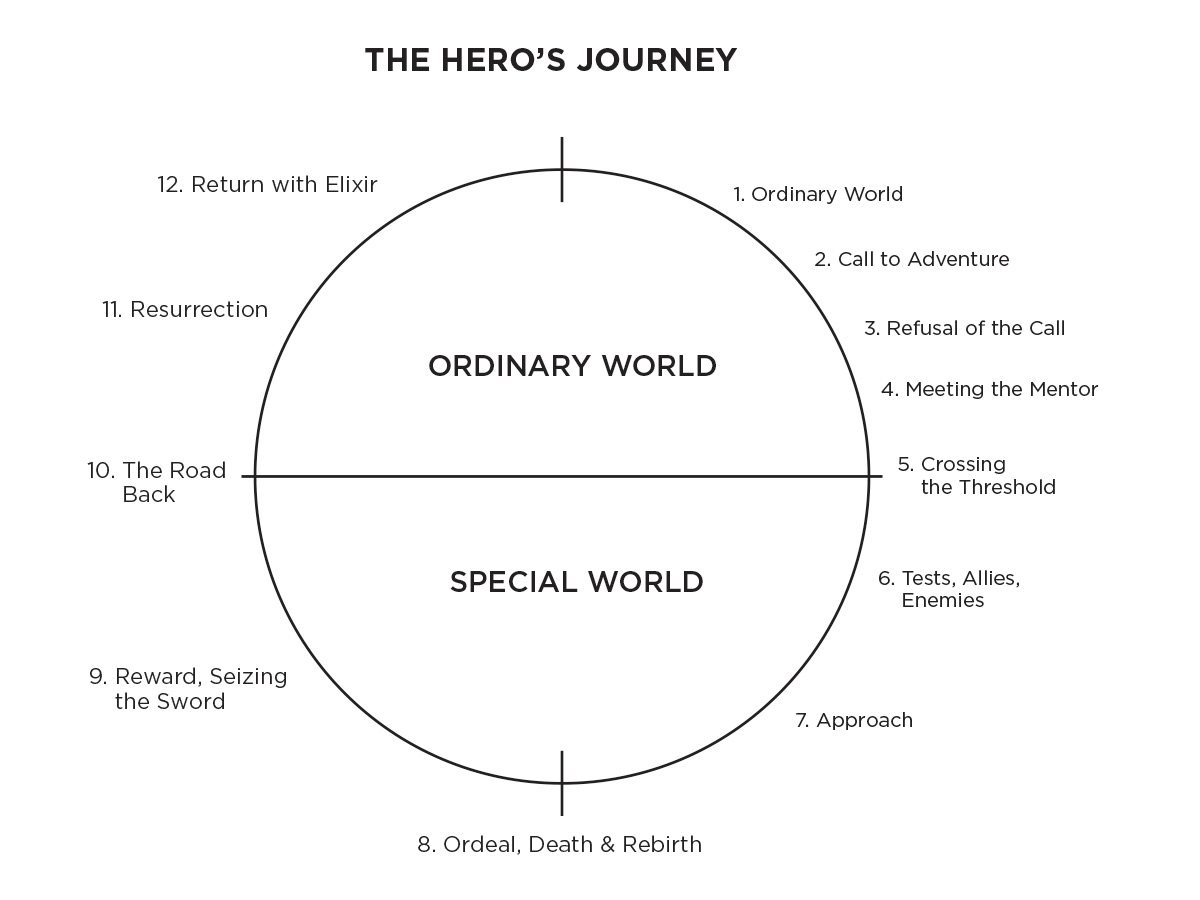
(The Hero's Journey Diagram, 2018)
This theory can be applied to many modern movies where an adventure takes place, including the 2016 film Kubo and the Two Strings.
Ordinary World - Kubo is a storyteller who takes care of his sick mother. He is not allowed to stay up after dark, as his mother fears her sisters and father will come and take Kubo away from her.
Call to Adventure - Kubo, convinced by a lady in the town he lives near, stays up after dark to try and talk to his father at an annual festival. Residents light a lantern to aid their ancestors in the spirit world. He stays up after dark and his aunts appear to take him.
Refusal of the call - He runs from his aunts, not wanting to engage them. He tries to go back to the cave in which his mother resides to be safe. His mother wants him to find his fathers armour, so she helps him escape but Kubo doesn't accept this and tries to stay with his mother only to fail.
Supernatural aid - From the beginning of the film he's had the power to control paper with his guitar. But in this instance his mother, with the last of her power, takes his guitar and stops his sisters, making Kubo escape. She also brings Kubos monkey statue to life, so he has aid from that as well. His mother dies in this last act.
Crossing the first threshold - Kubo gets three questions from the monkey, and wastes them all trying to figure out what exactly happened. He refuses to accept this as reality, and mocks the monkey. As he asks what to do, the monkey mentions his fathers armour again. He slowly accepts what he has to do, and falls asleep. In the morning an origami man appears to guide them, and Kubo follows him, finally crossing the first threshold. His guardian in this sense is his inability to accept whats happening.
The Road of the Trials - Kubo learns that his magic to control the paper is now stronger, and the stronger he gets, the more dangerous things will be. Kubo learns to control his magic more. He meets a samurai, claiming to be his fathers apprentice, and he vows to help Kubo on his way. They continue to follow the origami man. As they journey on, they come across a cave and fall down into its deepest parts. There they find part of his fathers armor, The Sword Unbreakable. It turns out to be a fake and a trap, and there they must fight a giant skeletal monster. They struggle at first, but Kubo manages to find the real sword just in time.
Kubo, still learning about his powers, manages to build a boat out of leaves, thus proving his pwoers are growing and that he's controlling them. The samurai teaches Kubo to shoot an arrow, as they all learn about eachother and start to get along as friends.
Belly of the whale - While on the long lake they find that the second piece of armor is under the lake. The samurai jumps in to get it and when he doesn't come back for a while Kubo jumps in after him. The monkey gets attacked by Kubos aunts. Whilst underwater, Kubo gets attacked by a beast that controls his mind. All our protagonists in this case are in their own respective "belly of the whale".
Meeting with the Goddess - Kubo discovers that the Monkey and the Samurai are actually his mother and father reborn.
Woman as temptress - In a dream, Kubo meets with his grandfather, the one who wants his other eye, and the antagonist of this story. He tells Kubo where the last piece of armor is, however Kubo is unaware the man was his grandfather, and that this is a trap.
It was from here that identifying the stages became a little trickier. Not only are they in a slightly different order, but they don't exactly match up exactly with these steps of the monomyth.

It was from here that identifying the stages became a little trickier. Not only are they in a slightly different order, but they don't exactly match up exactly with these steps of the monomyth.

(Kubo and the Two Strings, 2016)
Atonement with the father - This stage, doesn't exactly exist within the final acts, but rather throughout the film itself. Kubo gets acceptance from the Monkey (his mother) and the Samurai (his father) in the times he starts to realize who they are.
Apotheosis - When the protagonists arrive at the location of the last piece of armor, it does indeed turn out to be a trap. The aunts attack them, but they manage to hold her off. It is at this point that the aunt kills the father, and the mother, due to injuries, dies too, but not before Kubo, in a fit of passion, kills the Aunt. In this moment of realizing who he is and where he's from, he realizes what he must do, and achieves his full strength in power.
Ultimate Boon - In the beginning of the film, Kubo lives in a village, which happens to be the place where he got his Call to Adventure. In order to get the real last piece of armor, he must return there. This being his Ultimate Boon, where he returns to the village, and gets the last piece of armor.
Refusal of the return - This stage is nonexistent, Kubo does not hesitate to return to his original task, and bravely goes back to the village and gets the last piece of armor. This way he can defeat his grandfather, who was the real villain all along.
Magic flight - The final big fight of the film is when Kubo confronts his grandfather after returning to the village. The grandfather turns into a giant bug like creature when Kubo refuses to give him his eye, and they fight.
Rescue from without - Once the battle is over, and Kubo has defeated his grandfather, Kubo chooses not to kill his grandfather. Instead the grandfather loses his memories. This in its own way can be a rescue from without. But just after this, the village people are seen to be alive and come and tell the grandfather his "story", albeit a fake one. In this sense, the village people saved Kubo.
The crossing of the return threshold - This step is nonexistant as well, as there is no "final" fight, and there is no crossing of this threshold. Kubo accepted long ago that this was what he had to do.
Master of two worlds - This one is slightly harder to put into context with this movie. As Kubo has been the Master of two worlds throughout. He knew about his powers to control paper since the beginning, and also had a knowledge of the village, and the mothers past.

(Kubo and the Two Strings, 2016)
Freedom to live - Kubo completes the annual festival with the rest of the village, speaking to his mother and father, and seeing their spirits off as the movie ends. He is free to live in this world with the village, and knowing that his mother and father are looking over him.
Bibliography:
Images:
The Hero's Journey Diagram. (2018). [image] Available at: https://d1y9uiksrn06av.cloudfront.net/wp-content/uploads/2015/08/hero-chart.jpg [Accessed 1 Oct. 2018].
Kubo and the Two Strings. (2016). [DVD] Directed by T. Knight. United Sates: Laika.
Kubo and the Two Strings. (2016). [DVD] Directed by T. Knight. United Sates: Laika.
Wednesday, 26 September 2018
Collaboration - Star Wars Original Trilogy (1980)

(Star Wars: The Empire Strikes Back Poster, 1980)
The original Star Wars Trilogy, are American Space Western Films, directed by Irvin Kershner, George Lucas and Richard Marquand. As part of Star War's 20th anniversary celebration in 1997, This original trilogy was remastered and re-released under the title Star Wars Trilogy: Special Edition.
The changes in these films span from 1977 to 2011. These changes have been center of huge controversy within the fan base. Some fans welcomed the changes, while others feel it takes away from the history of the series. Putting all these fancy new special effects over the original vfx, removes the hard work put into the original film. This is most evident in The Empire Strikes back, in the scenes where the crew are escaping from Cloud City. In the original 1980 film, they are running through white halls, whereas in the 2011 remaster, there are beautifully painted backgrounds.

(The Empire Strikes Back, 1980)
A famous change in the original Star Wars movie bears the title of "Who shot first?". The scene in the original 1977 movie, has Han shoot first. Han Solo is meant to be a mercenary and an Anti-Hero. The scene where he shoots Greedo establishes this, as while Greedo is giving a monologue about killing him, Han takes advantage of his being distracted and shoots him. In the remastered Special Edition, it was changed, with Greedo shooting first.
"Having Greedo shoot first undermines all of that. Lucas says that he altered the scene to make Han seem less unscrupulous and more like the hero he would eventually become. The point of character development is that the character changes, though. Han is supposed to amoral to begin with and becomes more heroic as time goes by." (T, 2011)

(Star Wars, 1977)
In an interview with George Lucas in 2012, Alex Ben Block asked about the who shot first controversy. Lucas States that they always intended Greedo to shoot first, and the way the movie was cut originally made that confusing, and when they made that clear in the remastered version, people got mad because they wanted Han to be a cold blooded killer.
"I hate to tell people that. It’s a movie, just a movie. The controversy over who shot first, Greedo or Han Solo, in Episode IV, what I did was try to clean up the confusion... ...I put a little wider shot in there that made it clear that Greedo is the one who shot first, but everyone wanted to think that Han shot first, because they wanted to think that he actually just gunned him down." (Lucas, 2012)
However, according the original script from 1977, Solo was the first shooter. Peter Mayhew, the man who plays Chewbacca, tweeted out pictures of the original script that he kept.

(Mayhew, 2016)
"Not only does Han Solo shoot Greedo down, he does so in the middle of a quip. While the script does include a longer exchange between Greedo (simply called "Alien" here) and Han,... ...it seems fairly clear that the only shot fired comes from Solo. There is no mention of the bounty hunter somehow being missed at point blank range." (Libbey, 2018)
So who's right? The director George Lucas? Or the Fans of the show? There's been so many changes to these movies its difficult to tell, and as long as this remains a subject in Pop Culture as a media we'll never know.
Star Wars at this point, has been edited so many times, its difficult to say if it even belongs to the original creators anymore, especially since fans make their own versions of the franchise, and many others, in Fan Created content. Star Wars (1977) belongs to Fox, and the rest of the franchise was bought by Disney. So it's hard to say who truly owns this iconic series, and who will in the future.
Bibliography:
Images:
Kastel, R. The Empire Strikes Back (1980). [image] Available at: https://upload.wikimedia.org/wikipedia/en/3/3c/SW_-_Empire_Strikes_Back.jpg [Accessed 26 Sep. 2018].
The Empire Strikes Back. (1980). [DVD] Directed by I. Kershner. United States: 20th Century Fox.
Star Wars. (1977). [DVD] Directed by G. Lucas. United States: 20th Century Fox.
Mayhew, P. (2016). [image] Available at: https://twitter.com/TheWookieeRoars/status/705043238382604288?ref_src=twsrc%5Etfw%7Ctwcamp%5Etweetembed%7Ctwterm%5E705043238382604288&ref_url=https%3A%2F%2Fwww.cinemablend.com%2Fnew%2FEnds-Star-Wars-Han-Shot-First-Debate-Once-All-115797.html [Accessed 26 Sep. 2018].
Star Wars. (1977). [DVD] Directed by G. Lucas. United States: 20th Century Fox.
Mayhew, P. (2016). [image] Available at: https://twitter.com/TheWookieeRoars/status/705043238382604288?ref_src=twsrc%5Etfw%7Ctwcamp%5Etweetembed%7Ctwterm%5E705043238382604288&ref_url=https%3A%2F%2Fwww.cinemablend.com%2Fnew%2FEnds-Star-Wars-Han-Shot-First-Debate-Once-All-115797.html [Accessed 26 Sep. 2018].
Quotes:
T, J. (2011). The 10 worst crimes against the original Star Wars trilogy. [online] Den of Geek. Available at: http://www.denofgeek.com/movies/star-wars/17281/the-10-worst-crimes-against-the-original-star-wars-trilogy [Accessed 26 Sep. 2018].
Block, A. (2012). 5 Questions With George Lucas: Controversial 'Star Wars' Changes, SOPA and 'Indiana Jones 5'. [online] The Hollywood Reporter. Available at: https://www.hollywoodreporter.com/heat-vision/george-lucas-star-wars-interview-288523 [Accessed 26 Sep. 2018].
Libbey, D. (2018). Newly Discovered Star Wars Script Answers The Who Shot First Riddle. [online] CINEMABLEND. Available at: https://www.cinemablend.com/new/Newly-Discovered-Star-Wars-Script-Answers-Who-Shot-First-Riddle-71911.html [Accessed 26 Sep. 2018].
Block, A. (2012). 5 Questions With George Lucas: Controversial 'Star Wars' Changes, SOPA and 'Indiana Jones 5'. [online] The Hollywood Reporter. Available at: https://www.hollywoodreporter.com/heat-vision/george-lucas-star-wars-interview-288523 [Accessed 26 Sep. 2018].
Libbey, D. (2018). Newly Discovered Star Wars Script Answers The Who Shot First Riddle. [online] CINEMABLEND. Available at: https://www.cinemablend.com/new/Newly-Discovered-Star-Wars-Script-Answers-Who-Shot-First-Riddle-71911.html [Accessed 26 Sep. 2018].
Tuesday, 25 September 2018
Collaboration - Ideas Process + Blog Link
Last week, during our briefing on Tuesday, we got our task for Collaboration. We were asked to choose randomly from envelopes, and our prompt was Forgotten or Failed Superheroes.
We then sat down for 20 minutes to think of initial ideas or prompts for this. We listed them on a spreadsheet below.

After this process, we decided to narrow down a few (highlighted) and develop them more. This led us to our current idea, which we will go into more detail on our blog, along with more details of the listed ideas above.
Our Idea currently is do make an instructional "1950s" esque instructional video, similar to Duck and Cover and Fallout's promo videos, which are inspired by this.
We then sat down for 20 minutes to think of initial ideas or prompts for this. We listed them on a spreadsheet below.

After this process, we decided to narrow down a few (highlighted) and develop them more. This led us to our current idea, which we will go into more detail on our blog, along with more details of the listed ideas above.
Our Idea currently is do make an instructional "1950s" esque instructional video, similar to Duck and Cover and Fallout's promo videos, which are inspired by this.
We go into more detail on our recent blog posts over at Pixel Moon Studios.
Subscribe to:
Posts (Atom)