Wednesday, 3 October 2018

Collaboration - Kubo and the Two Strings - The Hero's Journey

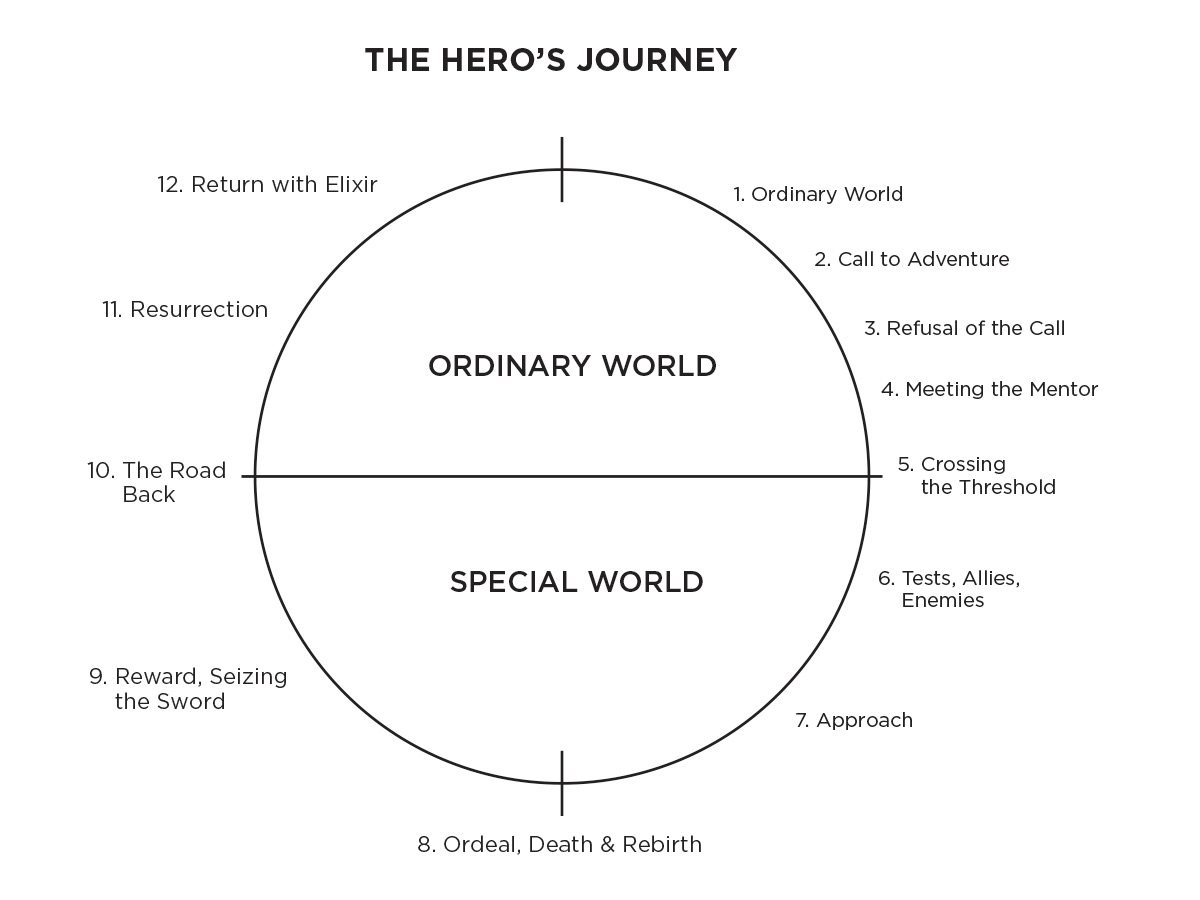
The Hero's Journey is a formula used in ancient myths as well as modern day books and movies. The original concept of the Hero's journey was made by Joseph Campbell in his book "The Hero with a Thousand Faces" and a refined version was made by Christopher Vogler in "The Writer's Journey".

(The Hero's Journey Diagram, 2018)

This theory can be applied to many modern movies where an adventure takes place, including the 2016 film Kubo and the Two Strings.

Ordinary World - Kubo is a storyteller who takes care of his sick mother. He is not allowed to stay up after dark, as his mother fears her sisters and father will come and take Kubo away from her.

Call to Adventure - Kubo, convinced by a lady in the town he lives near, stays up after dark to try and talk to his father at an annual festival. Residents light a lantern to aid their ancestors in the spirit world. He stays up after dark and his aunts appear to take him.

Refusal of the call - He runs from his aunts, not wanting to engage them. He tries to go back to the cave in which his mother resides to be safe. His mother wants him to find his fathers armour, so she helps him escape but Kubo doesn't accept this and tries to stay with his mother only to fail.

Supernatural aid - From the beginning of the film he's had the power to control paper with his guitar. But in this instance his mother, with the last of her power, takes his guitar and stops his sisters, making Kubo escape. She also brings Kubos monkey statue to life, so he has aid from that as well. His mother dies in this last act.

Crossing the first threshold - Kubo gets three questions from the monkey, and wastes them all trying to figure out what exactly happened. He refuses to accept this as reality, and mocks the monkey. As he asks what to do, the monkey mentions his fathers armour again. He slowly accepts what he has to do, and falls asleep. In the morning an origami man appears to guide them, and Kubo follows him, finally crossing the first threshold. His guardian in this sense is his inability to accept whats happening.

The Road of the Trials - Kubo learns that his magic to control the paper is now stronger, and the stronger he gets, the more dangerous things will be. Kubo learns to control his magic more. He meets a samurai, claiming to be his fathers apprentice, and he vows to help Kubo on his way. They continue to follow the origami man. As they journey on, they come across a cave and fall down into its deepest parts. There they find part of his fathers armor, The Sword Unbreakable. It turns out to be a fake and a trap, and there they must fight a giant skeletal monster. They struggle at first, but Kubo manages to find the real sword just in time.

Kubo, still learning about his powers, manages to build a boat out of leaves, thus proving his pwoers are growing and that he's controlling them. The samurai teaches Kubo to shoot an arrow, as they all learn about eachother and start to get along as friends.

Belly of the whale - While on the long lake they find that the second piece of armor is under the lake. The samurai jumps in to get it and when he doesn't come back for a while Kubo jumps in after him. The monkey gets attacked by Kubos aunts. Whilst underwater, Kubo gets attacked by a beast that controls his mind. All our protagonists in this case are in their own respective "belly of the whale".

Meeting with the Goddess - Kubo discovers that the Monkey and the Samurai are actually his mother and father reborn.

Woman as temptress - In a dream, Kubo meets with his grandfather, the one who wants his other eye, and the antagonist of this story. He tells Kubo where the last piece of armor is, however Kubo is unaware the man was his grandfather, and that this is a trap.

It was from here that identifying the stages became a little trickier. Not only are they in a slightly different order, but they don't exactly match up exactly with these steps of the monomyth.

(Kubo and the Two Strings, 2016)

Atonement with the father - This stage, doesn't exactly exist within the final acts, but rather throughout the film itself. Kubo gets acceptance from the Monkey (his mother) and the Samurai (his father) in the times he starts to realize who they are.

Apotheosis - When the protagonists arrive at the location of the last piece of armor, it does indeed turn out to be a trap. The aunts attack them, but they manage to hold her off. It is at this point that the aunt kills the father, and the mother, due to injuries, dies too, but not before Kubo, in a fit of passion, kills the Aunt. In this moment of realizing who he is and where he's from, he realizes what he must do, and achieves his full strength in power.

Ultimate Boon - In the beginning of the film, Kubo lives in a village, which happens to be the place where he got his Call to Adventure. In order to get the real last piece of armor, he must return there. This being his Ultimate Boon, where he returns to the village, and gets the last piece of armor.

Refusal of the return - This stage is nonexistent, Kubo does not hesitate to return to his original task, and bravely goes back to the village and gets the last piece of armor. This way he can defeat his grandfather, who was the real villain all along.

Magic flight - The final big fight of the film is when Kubo confronts his grandfather after returning to the village. The grandfather turns into a giant bug like creature when Kubo refuses to give him his eye, and they fight.

Rescue from without - Once the battle is over, and Kubo has defeated his grandfather, Kubo chooses not to kill his grandfather. Instead the grandfather loses his memories. This in its own way can be a rescue from without. But just after this, the village people are seen to be alive and come and tell the grandfather his "story", albeit a fake one. In this sense, the village people saved Kubo.

The crossing of the return threshold - This step is nonexistant as well, as there is no "final" fight, and there is no crossing of this threshold. Kubo accepted long ago that this was what he had to do.

Master of two worlds - This one is slightly harder to put into context with this movie. As Kubo has been the Master of two worlds throughout. He knew about his powers to control paper since the beginning, and also had a knowledge of the village, and the mothers past.

Image result for kubo and the two strings ending
(Kubo and the Two Strings, 2016)

Freedom to live - Kubo completes the annual festival with the rest of the village, speaking to his mother and father, and seeing their spirits off as the movie ends. He is free to live in this world with the village, and knowing that his mother and father are looking over him.

Bibliography:


Images:


The Hero's Journey Diagram. (2018). [image] Available at: https://d1y9uiksrn06av.cloudfront.net/wp-content/uploads/2015/08/hero-chart.jpg [Accessed 1 Oct. 2018].

Kubo and the Two Strings. (2016). [DVD] Directed by T. Knight. United Sates: Laika.

Friday, 28 September 2018

Toolkit 2 - Character Design: Research

During the Character Design briefing I received my starting point character that i'll be developing over these 9 weeks. My character is Shark and I shall reveal my other traits and details as I go along these weeks. This research is purely visual for now, and as I go on I will be looking at different angles of each trait. For now this is some research of sharks from different angles so I can start to draw them from reference.

Wednesday, 26 September 2018

Collaboration - Star Wars Original Trilogy (1980)

(Star Wars: The Empire Strikes Back Poster, 1980)

The original Star Wars Trilogy, are American Space Western Films, directed by Irvin Kershner, George Lucas and Richard Marquand. As part of Star War's 20th anniversary celebration in 1997, This original trilogy was remastered and re-released under the title Star Wars Trilogy: Special Edition.

The changes in these films span from 1977 to 2011. These changes have been center of huge controversy within the fan base. Some fans welcomed the changes, while others feel it takes away from the history of the series. Putting all these fancy new special effects over the original vfx, removes the hard work put into the original film. This is most evident in The Empire Strikes back, in the scenes where the crew are escaping from Cloud City. In the original 1980 film, they are running through white halls, whereas in the 2011 remaster, there are beautifully painted backgrounds.

Image result for the empire strikes back cloud city changes
(The Empire Strikes Back, 1980)

A famous change in the original Star Wars movie bears the title of "Who shot first?". The scene in the original 1977 movie, has Han shoot first. Han Solo is meant to be a mercenary and an Anti-Hero. The scene where he shoots Greedo establishes this, as while Greedo is giving a monologue about killing him, Han takes advantage of his being distracted and shoots him. In the remastered Special Edition, it was changed, with Greedo shooting first.

"Having Greedo shoot first undermines all of that. Lucas says that he altered the scene to make Han seem less unscrupulous and more like the hero he would eventually become. The point of character development is that the character changes, though. Han is supposed to amoral to begin with and becomes more heroic as time goes by." (T, 2011)

(Star Wars, 1977)

In an interview with George Lucas in 2012, Alex Ben Block asked about the who shot first controversy. Lucas States that they always intended Greedo to shoot first, and the way the movie was cut originally made that confusing, and when they made that clear in the remastered version, people got mad because they wanted Han to be a cold blooded killer.

"I hate to tell people that. It’s a movie, just a movie. The controversy over who shot first, Greedo or Han Solo, in Episode IV, what I did was try to clean up the confusion... ...I put a little wider shot in there that made it clear that Greedo is the one who shot first, but everyone wanted to think that Han shot first, because they wanted to think that he actually just gunned him down." (Lucas, 2012)

However, according the original script from 1977, Solo was the first shooter. Peter Mayhew, the man who plays Chewbacca, tweeted out pictures of the original script that he kept.

(Mayhew, 2016)

"Not only does Han Solo shoot Greedo down, he does so in the middle of a quip. While the script does include a longer exchange between Greedo (simply called "Alien" here) and Han,... ...it seems fairly clear that the only shot fired comes from Solo. There is no mention of the bounty hunter somehow being missed at point blank range." (Libbey, 2018)

So who's right? The director George Lucas? Or the Fans of the show? There's been so many changes to these movies its difficult to tell, and as long as this remains a subject in Pop Culture as a media we'll never know.

Star Wars at this point, has been edited so many times, its difficult to say if it even belongs to the original creators anymore, especially since fans make their own versions of the franchise, and many others, in Fan Created content. Star Wars (1977) belongs to Fox, and the rest of the franchise was bought by Disney. So it's hard to say who truly owns this iconic series, and who will in the future.


Bibliography:

Images:

Kastel, R. The Empire Strikes Back (1980). [image] Available at: https://upload.wikimedia.org/wikipedia/en/3/3c/SW_-_Empire_Strikes_Back.jpg [Accessed 26 Sep. 2018].

The Empire Strikes Back. (1980). [DVD] Directed by I. Kershner. United States: 20th Century Fox.

Star Wars. (1977). [DVD] Directed by G. Lucas. United States: 20th Century Fox.

Mayhew, P. (2016). [image] Available at: https://twitter.com/TheWookieeRoars/status/705043238382604288?ref_src=twsrc%5Etfw%7Ctwcamp%5Etweetembed%7Ctwterm%5E705043238382604288&ref_url=https%3A%2F%2Fwww.cinemablend.com%2Fnew%2FEnds-Star-Wars-Han-Shot-First-Debate-Once-All-115797.html [Accessed 26 Sep. 2018].

Quotes:

T, J. (2011). The 10 worst crimes against the original Star Wars trilogy. [online] Den of Geek. Available at: http://www.denofgeek.com/movies/star-wars/17281/the-10-worst-crimes-against-the-original-star-wars-trilogy [Accessed 26 Sep. 2018].

Block, A. (2012). 5 Questions With George Lucas: Controversial 'Star Wars' Changes, SOPA and 'Indiana Jones 5'. [online] The Hollywood Reporter. Available at: https://www.hollywoodreporter.com/heat-vision/george-lucas-star-wars-interview-288523 [Accessed 26 Sep. 2018].

Libbey, D. (2018). Newly Discovered Star Wars Script Answers The Who Shot First Riddle. [online] CINEMABLEND. Available at: https://www.cinemablend.com/new/Newly-Discovered-Star-Wars-Script-Answers-Who-Shot-First-Riddle-71911.html [Accessed 26 Sep. 2018].

Tuesday, 25 September 2018

Collaboration - Ideas Process + Blog Link

Last week, during our briefing on Tuesday, we got our task for Collaboration. We were asked to choose randomly from envelopes, and our prompt was Forgotten or Failed Superheroes.

We then sat down for 20 minutes to think of initial ideas or prompts for this. We listed them on a spreadsheet below.


After this process, we decided to narrow down a few (highlighted) and develop them more. This led us to our current idea, which we will go into more detail on our blog, along with more details of the listed ideas above.

Our Idea currently is do make an instructional "1950s" esque instructional video, similar to Duck and Cover and Fallout's promo videos, which are inspired by this.


We go into more detail on our recent blog posts over at Pixel Moon Studios.

Toolkit 2 - Action Arcs

Original Reference
Volleyball 1
Volleyball 2

Huh?

Running

 Ballet

Saturday, 8 September 2018

Personal - Music Video


A few weeks ago I started development of my own vocal synth with helpful advice from the studio I volunteer from. I edited this video together of a cover of a Japanese vocal synth song.

cover settings - yusukekira
vocal synth - voiced, edited and managed by myself
vocal mixing - myself
original song - giga-p and reol
art - outsourced from emimelon
video - myself

It took about a week of work to finish this video and it was a fun ride messing with effects and such. I'm happy with how it came out.

Wednesday, 4 July 2018

Personal - Messing in After Effects

Today I decided to experiment a little with adobe after effects 3d settings. So I built a simple room, added some lighting and a camera, and proceeded to mess around a little. Making the room was difficult, but I got the hang of it by the end.

I then imported one of the drawings I'd done and moved it back in the scene, making sure the foot touches the floor or the 3d scene, and that the lighting is in a correct place for the shadows to fall.

Then I simply played around with the camera, moving it in the scene using the properties and also within the scene itself. There are a lot of possibilities for video making within these tools, and once you get the hang of them it's actually quite simple.

Monday, 18 June 2018

Personal - Vocal Synth Designs


Since I joined the vocal synth studio as a volunteer, I've been experimenting with the same program they use to make my own vocal synth characters. I probably won't take them too far. But I'll try to develop one and see how it goes. These are the characters I have for now, plus different Modules for different "voice types".

Thursday, 14 June 2018

Personal - Pride Month Studio work


For the last few weeks, I've been working with an Indie "vocal synth" studio called Studio Ogien to produce this Pride art in celebration of Pride Month. The work I do for this studio is completely voluntary for now, but its good to expand my horizons in the future. They also gave me permission to upload this to my blog.

The criteria for the piece was a lighthearted mood, showcasing the four main girls of the group. I put forward the idea of a Pride festival, with the four main girls celebrating a "teaser" of one of the new girls (which is in the form of a finger covering the lens) and I also asked the other members of the studio, if they wanted their own characters put in the background to flesh the scene out. I also planned the scene out to be like a snapchat photo.

Original Sketch

Tuesday, 15 May 2018

Fantastic Voyage - Reflective Statement

This time last year I was very unhappy with what I was doing creatively. The course I was pushed onto just wasn't for me. So choosing to come study at CAA was a very big step for me. And I have to say I've loved every second of it. Even all the stress and low moments. And I wouldn't take back my decision for the world. Fantastic Voyage was a dream come true for me. Getting to direct, produce and animate my own short film was just amazing, and one year ago I never even thought I'd ever get to this point in life.

Although my short film could use many improvements (mostly in the animation portion), I am very proud of what I've managed to produce on this course. But I do admit, I bit off a bit more than I could chew with this project. I went in excited and wanted to impress. I really wanted to use NCloth, so much so that I never created a backup plan when NCloth went downhill. In hindsight, creating a version of my rig that allowed me to move the dress/poncho/filament as separate parts would have been the best thing before experimenting with NCloth, and I'm a little mad at myself for being so lazy with the rigs and just wanting to dive into NCloth. I really needed that backup plan with the dress rigs, because my animation suffered as a result.

I need to improve in this planning aspect, otherwise, my work could suffer in the future. I also want to improve in the animation aspect so that my characters don't look like they're floating in space. I'm looking forward to my second year at CAA, and I hope to improve in all ways possible next year and over the summer.